


History of area
The first confirmed reference to mining activity in Witting can be found in a letter from King Eric XIV of Sweden, dated 6 March 1563.
History of area
The first confirmed reference to mining activity in Witting can be found in a letter from King Eric XIV of Sweden, dated 6 March 1563. In the letter, the king inquires about Hans Ingersson’s activities in ore extraction in the Kyrö parish (Kyrun), from which Ylistaro was later separated as its own parish. The location mentioned was called Silferberg (“Silver Mountain”), in what is now the village of Witting.
As the name Silferberg suggests, there were likely early hopes of finding silver. However, Governor Melcher Wernstedt was later ordered to burn (fire-set) the rock in Witting to a depth of one fathom (1.78 m) and send samples of copper ore to Stockholm for analysis. This indicates that copper, in addition to iron, was also a key target of interest.
Witting is known as the site of Finland’s second oldest iron mining area, and mining activity here can be seen as one of the early driving forces behind industrial development in Ostrobothnia. Finland’s first ironworks in the region was established in Orisberg in 1676, originally based on ore from Witting.
The only effective mining method in the 16th and 17th centuries was fire-setting. All required materials were readily available: firewood, water, and labour. A fire was built on the rock surface, heating it intensely before it was rapidly cooled with water. The sudden temperature change caused the rock to crack. Wedges and hammers were then used to break off fragments, and ore-rich pieces were sorted by hand. Waste rock was piled into large heaps or used to fill previously abandoned pits.
Work continued in cycles of heating and cooling as long as it remained profitable. As the pit grew deeper, more firewood was required and extraction became more difficult. One limiting factor may also have been the availability of oxygen at greater depths. It is likely that broken rock was lifted out using a horse-powered winch or similar lifting device. The deepest fire-set mine in Witting is 5.8 metres.
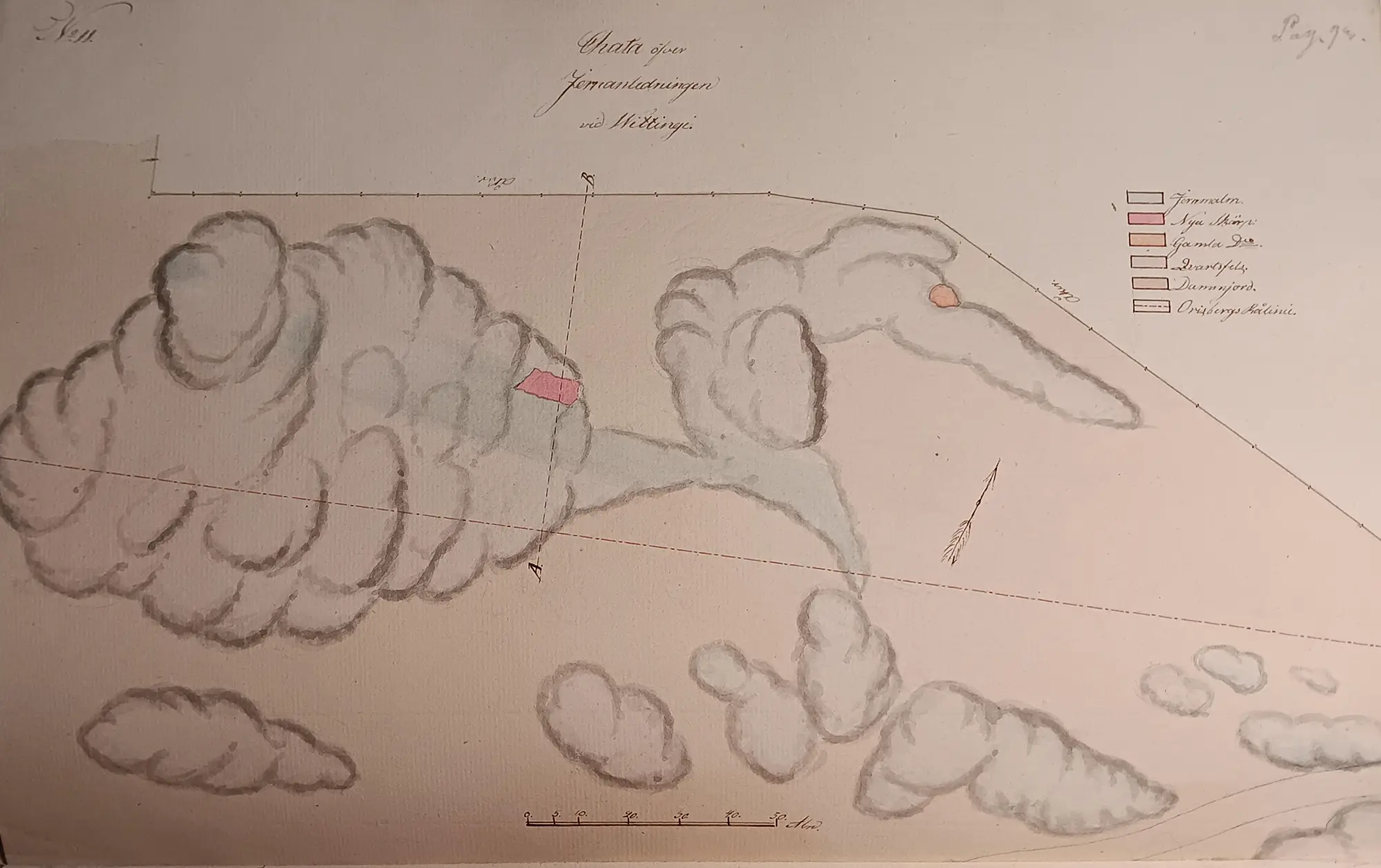
The first fire-set mine in Witting was only discovered in August 2019. Since then, several more have been identified. Fire-set mines are characterised by smooth rock surfaces and rounded shapes at the bottom. Mine 13 is a good example of this type. Well-preserved fire-set mines are rare in Finland, but a few exist. However, the Witting mines are the only ones that are easily accessible and publicly viewable.
Mining methods changed in the 18th century as the use of gunpowder became more common. In gunpowder mining, holes were drilled into the rock. Drilling teams usually consisted of two men: one holding the drill while the other struck it with a hammer. The mining foreman marked the drilling points, which were then assigned to teams by lot. Once the holes were deep enough, coarse gunpowder was poured into them and packed tightly with crushed brick. During tamping, a thin iron rod was kept in the hole and later removed to create a channel for a fuse made of sulphur-soaked flax. All charges were detonated simultaneously, and the broken rock was then lifted and sorted.
Dynamite mining became common in the late 1860s and followed similar principles to gunpowder mining but was significantly more efficient. Mining activity in Witting began to decline towards the 20th century and later consisted mainly of experimental and research work. Dynamite was used only to a limited extent in Witting.
Kyrönkankaantie (the Kyrönkangas historic road)
Kyrönkankaantie was once the only route from Southern Finland to Ostrobothnia, enabling travel even during the summer months. References to the road running from Hämeenlinna to Korsholma (now part of Vaasa, Finland) date back to 1459. The name originates from Kyrö in Satakunta, now known as Hämeenkyrö. The Könnintie between Ylistaro and Ilmajoki is part of this old main road.
The road has a colourful history of nearly 600 years and has been used by both kings and military forces. King Gustav II Adolf of Sweden is known to have travelled along it at least in 1614 on his way to inspect mining areas in Southern Finland, and he may also have passed the mines in Witting during the same journey. He travelled the route again in 1626 when returning from Narva.
King Adolf Frederick visited Finland in 1752 and inspected, among other sites, the construction of Suomenlinna. He also travelled along the Kyrönkangas road through Ylistaro, returning to Sweden via Tornio. Adolf Frederick died in 1771 after eating a “royal dinner” consisting of sauerkraut, turnips, caviar, lobster and smoked herring. For dessert he consumed 14 semla pastries and drank champagne. It is said that this overindulgence caused his death.
During the Cudgel War of 1596–1597, both the troops of Klaus Fleming and the peasant rebels used the Kyrönkankaantie route. According to tradition, the rebels had a defensive ambush (a military obstacle) in the Hietikko–Jääskänjoki area, where they intended to surprise Fleming’s forces. However, the battle took place in Kurikka. The Russian military commander Mikhail Golitsyn marched thousands of cavalry and infantry along Kyrönkankaantie, totalling around 10,000 soldiers to Ylistaro. The troops camped in Pelmaa, where they regrouped for the Battle of Napue in February 1714.
The Witting mining area also attracted a varied range of travellers. Lorenz Creutz, who served in the Swedish Board of Mines, is said to have visited and inspected the mines. It is claimed that Creutz was the wealthiest man in Finland of all time, with wealth that was impossible to fully measure. During the witch hunts, Creutz led the Dalarna Witch Commission, where he sentenced twenty “witches” to be burned. Lorenz Creutz was appointed admiral without any formal military training and became commander of Sweden’s largest warship, Stora Kronan. In 1676, off the east coast of Öland, Creutz turned the ship too sharply in battle conditions, causing it to capsize and its powder magazine to explode. Stora Kronan sank, taking Creutz and over 800 sailors with it.
Perhaps the most famous murderer of his time, Matti Haapoja, began his criminal career along Kyrönkankaantie. At the age of 11, Haapoja left home and walked along the road to Turku. His intention was to sign on as a sailor, but he changed his mind at the recruitment office. A few months later he returned to Ylistaro. Haapoja committed his first killing at the age of 24 at a wedding house in Witting, where he stabbed his friend Heikki Impponen to death. Along the same road, in the forest section between Hietikko and Tehtaanmäki, Haapoja shot his acquaintance Esaias Nyrhinen in the jaw with a pistol. Nyrhinen managed to escape and survived. The list of events along Kyrönkankaantie is endless.
The Witting inn has served travellers along Kyrönkankaantie since the late 1680s, first as a tavern and later as a coaching inn, until 1916.
The first complaints about the poor condition of Kyrönkankaantie began to appear in the late 1600s. Now that we are living in the 2020s, the matter will surely be resolved soon.